
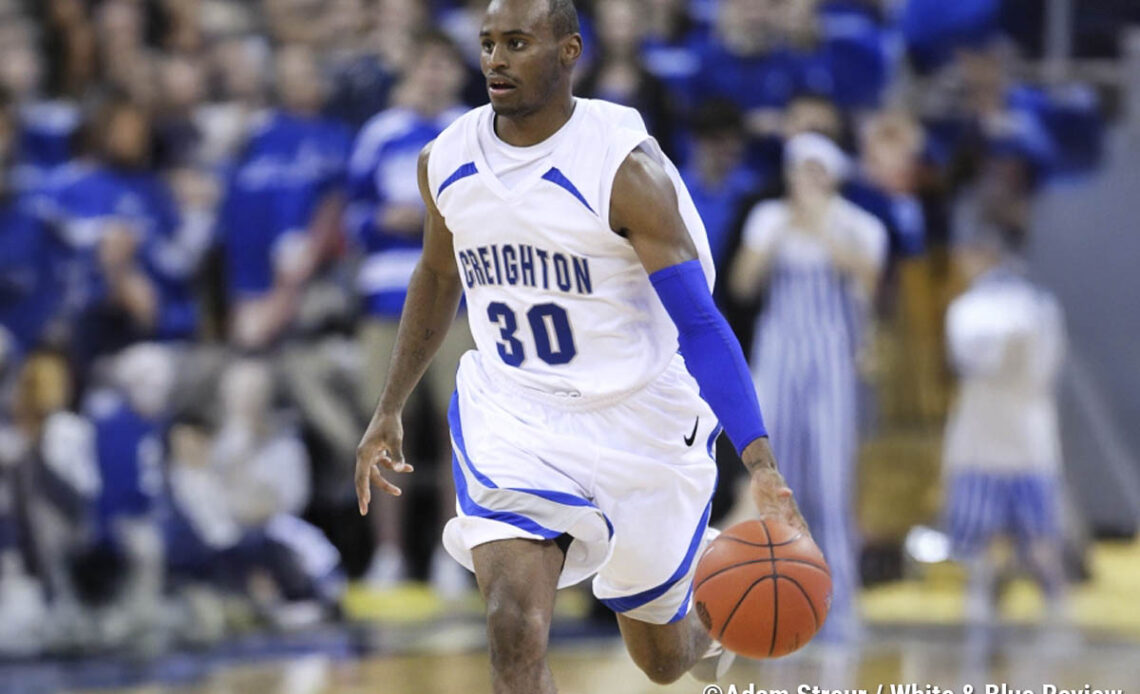
In collaboration with Jays Classic, White & Blue Review is looking back at the “Greatest Jays of the Modern Era” through exclusive highlight reels and features in this occasional series. Check out the Jays Classic microsite for the full rankings and more details.
Point guards from Bellevue West High School ran Creighton’s offense for seven straight seasons starting in 2005. First there was Josh Dotzler, a two-time Nebraska Player of the Year who seemed on track to be one of CU’s all-time greats before a series of injuries derailed his career. Then there was Antoine Young, who succeeded him twice — first as the starting point guard for the Thunderbirds, and then at Creighton. Both times, their tenures overlapped by one season, with Dotzler showing Young the ropes.
After committing to Dana Altman and the Bluejays when he was just 15 years old, during the summer before his sophomore year of high school, Young carved out a role immediately after arriving at CU. As a freshman, he averaged 4.9 points and 1.4 assists in 14 minutes per game as Dotzler’s primary backup at point guard. Over the final eight games, he scored in double figures four times and became harder and harder to take off the floor, sometimes playing off the ball alongside Dotzler in an effort to find more minutes for him. Among his big games down the stretch were a 15-point performance (all in the second half) in a win over Evansville, 13 points on 4-of-4 shooting in a BracketBuster win over George Mason, 10 points in their MVC Quarterfinal win over Wichita State, and 12 points on 5-of-6 shooting in an NIT win over Bowling Green.
As a sophomore, he took over the reigns at point guard and struggled initially with new role. Through 16 games, he had 45 assists to just 22 turnovers, but had scored in double figures just twice and ranked sixth on the team in scoring. His offensive woes were most acute at the free throw line, where was 20-of-41 (48.7%) over those first 16 contests. That was a huge problem, as opponents could simply foul Young every time he got close to the rim and dare him to make a free throw — and more than half the time, he couldn’t.
His sagging confidence, and his season, began to turn around on January 13. A hard-fought battle with Southern Illinois was tied at 69 with 36 seconds left, and rather than draw up a play to get Justin Carter (who had 19 points already that night) or leading scorer Kenny Lawson a shot at a game-winner, Altman put the game in Young’s hands.
He didn’t want SIU to have time to get a shot of their own, so he wanted his point guard to dribble as much time off the clock as he could and then create his own shot.
“Coach kept yelling, ‘Hold it, hold it, hold it,’ and I was getting nervous,” Young said after the game. As he was dribbling out the seconds and the anxiety was ratcheting up, Young gave himself a pep talk. “I needed to step up and make a play. So I treated it like I was a kid again, out on the driveway, counting down (the seconds).”
“I didn’t want to give them a chance to come down and get a shot. So I told him to hold it. We wanted to get a shot up. If we hit it, great. If we didn’t, let’s go to overtime,” Altman added.
After dribbling almost 30 seconds of clock away, Young made his move. He spotted a tiny crease, drove to his right through the Saluki defense, and when he saw his opening, took a jumper from eight feet out. It bounced in, and the Jays won.
“He’s a left-handed guy who went left on every possession all night. Then he goes right for the game-winner. That was a great individual play on his part,” Southern Illinois coach Chris Lowery said afterward, shaking his head in disbelief.
Hitting that shot was just what Young needed to bolster his sagging confidence. And over the final 10 games of the regular season, he was Creighton’s third-leading scorer (9.0 points per game), dished out 29 assists, and had 11 steals. He finished the year with a 2.5-to-1 assist-to-turnover ratio, tops in the Missouri Valley and 23rd nationally. And he made 15 of his last 18 from the free throw line after a rough start.
After the season, the coach he’d committed to as a teenager left for Oregon, and Young struggled to hide his disappointment. But he flourished under new head coach Greg McDermott. As a junior, he averaged 13.1 points and five assists per game while rarely leaving the floor — across 39 games, he played 1,393 minutes (35.7 minutes/game) to set a Creighton single-season record. It was also the most in the MVC since at least 1996-97 and second-most nationally behind UConn’s Kemba Walker.
Young led the Bluejays in assists, steals, free throws made and minutes played. He led the MVC in assist/turnover ratio (for the second straight season) and assists per game, was second in minutes per game, seventh in points per game, 12th in steals and 11th in free throw accuracy. He had 141 assists in the regular season, an astonishing 18 more than the next best player in the MVC. He was one of five players in the league to score 500 or more points that season. And he become the first MVC player in nearly two decades to lead the league in assists AND rank in the top 10 in scoring.
His tremendous season was overshadowed by teammate Doug McDermott, who became the first freshman to win first-team All MVC honors in 59 years. Even still, he might very well have been a first-team All MVC player himself if not for Northern Iowa’s Kwadzo Ahelegbe, the leader of a UNI team that won two regular season MVC titles, two MVC Tournament titles and advanced to an NCAA Sweet 16; Ahelegbe’s stellar senior season earned him that honor over Young.
Then came the CBI. That 2011 run through the second-tier postseason tourney has long been credited with being the emergence of Greg McDermott’s “Let it Fly” offensive style, but it was also where Young moved out of Doug McDermott’s shadow and began casting his own.
Over the first three games — double-digit wins over San Jose State, Davidson and Central Florida — Young had 38 points, 27 assists and zero turnovers.
Yes, zero.
“I’ve never seen anything like it,” Greg McDermott said after the win over UCF.
“Twenty-seven assists and zero turnovers – those numbers speak for themselves,” Kenny Lawson said. “But coming from a teammate’s perspective, I’m not really surprised because we all know how hard Antoine has worked. With his work ethic, the sky’s the limit. He’s just going to continue to get better.”
Against Davidson, he had 22 points and nine assists, barely missing out on the first point/assist double-double in nine years for a Bluejay (Tyler McKinney in 2002 had been the last). The disappointment didn’t last long, as Young had 16 points and 10 assists in the next round against UCF to secure his double-double.
Led by their point guard’s electric play, the Jays had scored 85, 102 and 82 points in those three wins after scoring 80 or more just four times over the first 33 games. The biggest beneficiaries? Gregory Echenique, who averaged 15.7 points in those three wins after scoring 9.9 points for the season, and Doug McDermott, who averaged 24.3 points.
“We’re clicking offensively, and guys have a lot of confidence in each other. We’re sharing the basketball better than we probably ever have. So we’ve opened it up a little bit offensively and we’re pushing the ball a little more than we were earlier in the season,” McDermott said. “As long as the guys continue to make good decisions, that’s something we’ll continue to do.”
They dropped two of three to Oregon in the CBI Finals, including a heartbreaker in Game Three. With two seconds left in a tie game, Young was whistled for an over-and-back call after stepping over the nearly-invisible half court line at Matthew Knight Arena. Oregon hit a game-winner and took the title.
“This tournament meant a lot to our team,” Young said afterward. “We got some more experience. We took advantage of it, and we played really well.”
With almost everyone returning, the 2011-12 Bluejays broke through for a historic campaign with Young captaining the ship. They tied the school record for wins with 29, equaling the great 2002-03 team. They started 7-0, lost a road game at Saint Joseph’s, then won their last three non-conference games. And after dropping the MVC opener against Missouri State, they won 11 in a row and were 21-2 (and 11-1 in the MVC) on February 1 following a 102-74 win over Illinois State.
The addition of Grant Gibbs to the backcourt meant Young’s overall numbers dipped somewhat, but his importance to the Jays’ success remained just as vital. Just as it was during their CBI run the previous March, while Doug McDermott was the straw that stirred the drink, Young was the one who put the ingredients together — the duo combined for 44.1% of the Jays’ points and took 43.2% of the team’s shots. In addition to averaging 12.1 points per game, Young dished out 4.5 assists per game (and 156 for the season) versus just 65 turnovers, an excellent 2.4 assist-to-turnover ratio that was identical to his mark as a junior. All those assists meant Young had a hand in roughly 1/3 of the team’s points between what he scored himself and what he created for others.
The team suffered a three-game losing streak in February, and then lost just once the rest of the season — an 87-73 defeat against #1 seed North Carolina in the second round of the NCAA Tournament. In between there were a career’s worth of thrilling victories squeezed into a month’s time, including two all-time classics in the span of four days. And Young was a key factor in all of them.
The first of those came in a late night BracketBuster matchup against Long Beach State. Trailing 79-75 with two minutes to play, Creighton ended the game on a 6-0 run to steal the win. And on the final possession, with the defense focused on McDermott who had scored 36 points on 14-of-20 shooting, it was Young who buried the game-winning shot at the buzzer. That shot, one of the most famous moments in arena history, made Young the first player in arena history with two game-winning scores.
In front of a rowdy, rambunctious crowd and a national television audience, against an incredibly talented opponent who had led virtually the entire game and turned away Bluejay rallies time after time, Young drove the lane as he’d done hundreds of times before, making the same slightly-off-balance shot he’d made hundreds of times before, to finally give his team a lead just as the game clock read all zeroes. Creighton students rushed the court, lifting Young up on their shoulders as the conquering hero, and who could blame them? In his second-to-last home game, the player who’d been a Bluejay since his 16th birthday when he became the youngest commit in school history finally had his moment.
“It’s just something that I was taught growing up. You live for moments like that,” Young said on the AM590 postgame show. “There’s players that either want to take that shot or don’t want to take that shot, and I want to take the shot. I feel like I’m confident enough that if I can get the last shot of a game, I can make it at anytime on anyone. So I just went out there relaxed, and knew I was going to make a play.”
“I told the guys, I’m not interested in an offensive rebound. I don’t want to leave three or four seconds for them,” Greg McDermott recalled on the postgame show. “The way they make shots, and as good as they are off the dribble and with Casper Ware being able to shoot it from 35 feet, we’re not giving it back to them. That maybe goes against what a lot of coaches would do. A lot of coaches want to shoot it at four, have a chance for an offensive rebound (if you miss).”
The plan coming out of the timeout was to take advantage of the fact that Long Beach State had been switching ball screens all game. Creighton stuck Ethan Wragge in the corner, and instructed Doug McDermott set a high ball screen for Young before diving hard to the basket, knowing he’d drag a guard with him. The rest was up to their floor general.
“If Antoine read that the defense had helped off Ethan, he was going to flip it to Ethan, who still would have had time to go inside to Doug too,” Greg McDermott said. “And if they covered them both — if they stayed home with Ethan and they stayed with Doug and they came from the weak side — then Antoine was going to back it out, against their frontline player, and Antoine was going to go get a shot. And, he went and got one.”
“I got switched out on the big, and so I was just trying to get him to shake a little bit so I could get him off,” Young said in describing the final play. “I finally got into it about six or seven seconds in, and kind of got into my rhythm, and then I realized he was a little taller than I thought! So I thought I needed to get into him a little bit to create some space, and I was able to. I thought he was going to tip it, actually, for a minute. But it felt really good when I let it go.”
Three nights later, Young scored 21 points and had seven assists as the Jays rallied from a 14-point deficit with eight minutes left to beat Evansville 93-92 in overtime. He scored four straight points during their big run to get them back into the game, and then on the final possession with the Jays trailing 83-81, it was once again Young who took the big shot.
This time he missed. So did Ethan Wragge, whose desperation tip-in was short. With no time left to catch the offensive rebound and shoot, Gregory Echnenique did the only thing he did have time for — a one-handed redirection of the missed shot that dropped through the net as time expired. The Jays would outlast the Aces in the extra period, with Young getting the scoring started. Then they survived a rare miss from UE star guard Colt Ryan, who had scored a then-facility-record 43 points. Young went 13-of-14 from the line en route to his 21 points, an unbelievable stat considering his free throw struggles earlier in his career.
The trend of narrow victories continued in the regular-season finale, as Creighton got a defensive stand in the closing seconds to top Indiana State, 61-60. Young scored 21 in that game, too, and scored or assisted on all of Creighton’s last seven points. Trailing 58-54 with 3:09 to play, his assist created an open three for Jahenns Manigat that got CU to within one. On the next possession, he drained a jumper to give the Jays the lead 59-58. And after a defensive stop, he hit two free throws to give the Jays a three-point lead — crucial shots considering ISU’s Jake Odum would make a layup with 10 seconds to play. But Young’s free throws had given them enough breathing room to survive.
Young would score 29 points over the first two games of the MVC Tournament, with nine assists and just two turnovers. And though he struggled somewhat in the championship, shooting an uncharacteristic 3-of-9 from the floor and 8-of-14 from the line with four turnovers, he made winning plays when it mattered most. Eight of his 14 points came in overtime, as he made a driving layup and then went a perfect 6-of-6 at the line in an 83-79 win.
He had trouble scoring against Alabama’s swarming defense in the first round of the NCAA Tournament, making a lone field goal in 31 minutes. But he had five assists and only two turnovers, giving their offense a steady floor leader in a 58-57 grinder of a game. And after he took his curtain call in the loss to North Carolina, he finished his career as CU’s first-ever player to score at least 1,325 points and dish 500 or more assists. He finished 17th on Creighton’s all-time scoring chart, and his 505 assists ranked third-most in Bluejay annals, with only Ryan Sears (570) and Ralph Bobik (549) having more at the time Young’s career ended. He made 107 consecutive starts, dating back to the second game of his sophomore season, and played in 142 games, the second-most ever by a Bluejay at the time.
After playing professional basketball in Amsterdam, Switzerland and Mexico, Young began his coaching career as a graduate assistant at MIAA-member Pittsburg State. He has a B.A. in Journalism from Creighton and a Masters from Pittsburg State, and spent six years as an assistant at Nebraska-Kearney before being named Interim Head Coach in 2023-24. He joined former Bluejay Alan Huss’ staff at High Point the following year as an assistant, and remains there under new coach Flynn Clayman.