
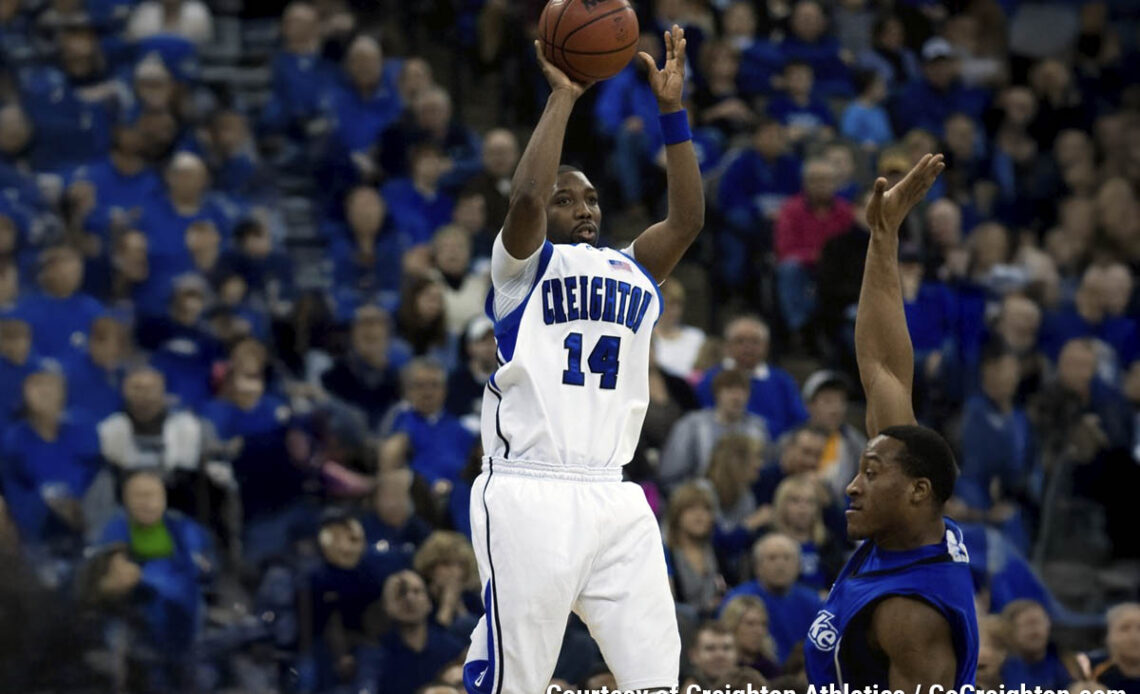
In collaboration with Jays Classic, White & Blue Review is looking back at the “Greatest Jays of the Modern Era” through exclusive highlight reels and features in this occasional series. Check out the Jays Classic microsite for the full rankings and more details.
***
April 2007 was a wild time on the Hilltop. On April 2, Dana Altman accepted the Arkansas job and was introduced as their new head coach at a 5:00pm event in Fayetteville. On April 3, he woke up with a change of heart and called Bruce Rasmussen at 6:00am to inquire about his old job. On April 4, he was re-introduced as the coach of the Bluejays. In the midst of that chaos, a pair of junior college guards were being recruited by the Jays to supplement a highly-touted recruiting class put in place before Altman’s dalliance with Arkansas.
P’Allen Stinnett (ranked #92 by Rivals), Kenton Walker (#148) and Kaleb Korver (younger brother of Kyle) were set to join the program. Louisville transfer Chad Millard, a top 150 player out of high school, would be eligible that fall. So too would Kenny Lawson, who had redshirted after a knee injury derailed his freshman campaign.
Cavel Witter, a 5’11” guard out of Kansas City, and Booker Woodfox, a 6’1” guard from Lewisville, Texas, soon joined them.
When the pair of guards signed with the Jays on April 11, it capped a whirlwind week for CU. And their addition capped what they hoped would be a class of newcomers that would allow them to reload, rather than rebuild, despite the loss of three starters from the year before (Nate Funk, Anthony Tolliver, and Nick Porter) — and reloading was doubly important after Altman’s employment detour.
“We’ve got caught short of guards the past couple of years because of injuries,” Altman said. “This will enable us to go back and play the style we prefer to play and to be a little more aggressive on the defensive and offensive ends. Their athleticism should help us.”
Speaking of Woodfox specifically, Altman simply said “Booker can shoot it.”
That’s what he was brought in to do. The 2006-07 team, despite winning the MVC Tournament and advancing to the NCAA tourney, was a terrible three-point shooting team. They made 33.8% as a group, the worst of any CU team in the Altman era to that point, and the third-worst of any CU team in the modern era. Assistant coach and lead recruiter Brian Fish recalled a frustrated Altman turning to him on the bench during one particularly poor-shooting game in 2007 and saying “Find me someone who can hit an outside shot.”
Enter Woodfox. He made 184 three-pointers in two seasons at San Jacinto College in Pasadena, Texas — 99 as a freshman, 85 as a sophomore — while making nearly 40% from his attempts from deep. And he made 147 more in two seasons at Creighton, making them at an even more efficient clip, believe it or not.
Basically a one-dimensional player, Woodfox wasn’t a terribly proficient passer, he didn’t get many rebounds, and he was frequently a liability on defense. But if your one dimension is elite, it can cover up for a lot.
And make no mistake, his shooting was ELITE.
Woodfox finished his career as the school-record holder for best career three-point shooting percentage (45.5%), most consecutive games with a made three (31), and most consecutive made free throws (36). The only player since then to shoot better from three over his career? Doug McDermott, who barely eclipsed it at 45.8%. McDermott is also the only player since to make more free throws in a row without a miss, making 45 straight his senior year. McDermott and Woodfox remain 1/2 in those categories to this day.
It took a decade for someone to make a three in more consecutive games than Woodfox did; Ty-Shon Alexander did it in 33 straight in 2018-19, and Baylor Scheierman in 48 straight games in 2022-23.
To date, Woodfox is still the record holder for best three-point shooting percentage at CHI Health Center, making an absurd 48.3% in his home games as a Bluejay. Next closest? Ethan Wragge, a light year away at 45.7%. And despite playing just two years, he was seventh on the all-time list for most three-pointers made in his career when he graduated; everyone else in the top 10 at that point had played at least three years at CU.
“After I saw him shoot the ball, I knew this was a no-brainer,” Altman said as Woodfox’s career was wrapping up in March 2009. “But I knew he was going to be a liability on defense, and we’d have to work through that. And he has. He’s worked hard defensively just to try to do a better job. To shoot the percentages that he did this year and to come on as strong as he did last year, I can’t say I saw that. To become the kind of shooter he’s been for us…wow. He hit tough shots, shots on the move. He hit so many big ones for us.”
“(Altman) didn’t have to bring me here,” Woodfox told the Omaha World-Herald in 2009. “He’s always been there for me. Even though I’ve struggled some times on the defensive end and I don’t dive after loose balls, Coach always keeps me in there. It’s like he knows I’m going to do something sometime during the game.”
He hit two game-winning shots, one on the road at Oral Roberts in a BracketBuster Saturday showdown and one in the quarterfinals of Arch Madness to take down Wichita State. He nearly made a third, with a would-be buzzer beater against Kentucky in the NIT rolling around the rim before falling out.
Winner of the 2008 MVC Sixth Man Award, the 2009 Larry Bird MVC Player of the Year Award (just the fourth Bluejay to do so at that time, joining Korver, Bob Harstad and Chad Gallagher) and a 2009 AP Honorable Mention All-American, Woodfox was also the leading scorer on a team that won the 2009 regular season MVC title. He’s the great forgotten Bluejay — did you remember his personal trophy case was that full of awards? — partially because his teams never made the NCAA Tournament, and partially because his time on the Hilltop came right before the explosion of social media and YouTube preserved highlights for fans to relive (and younger fans to see for the first time).
Let’s fix that.
***
In 2007-08, Woodfox’s first in Omaha, he gave the Jays the sort of bench production that would be the envy of any program. He scored in double figures in 17 of 33 games, including 14 straight from late January through the end of the season. As is typically the case with transfers, especially from the JuCo ranks, it took Woodfox about half a season to get adjusted — but once he did, there was no stopping him.
In the month of January, he made 18-of-33 from three-point range (54.5%). It started with 16 points in Terre Haute on January 2, torching Indiana State with five 3-pointers. He was even better in the rematch two weeks later, scoring 20 on six 3’s. Woodfox capped off the month with 19 points in 22 minutes at #16 Drake, making three more 3’s. And in February, he kept hitting threes at ridiculous rates, but started doing other things, too. On February 2, he had 10 points and three assists in a win over Wichita State. On the 10th, he scored 16 of his 20 points after halftime against Southern Illinois. A week later, he had 14 points and a season-high six assists in a win over Missouri State.
His first game-winner came on the 23rd, as Woodfox scored 14 points — including the go-ahead three-pointer with 26.5 seconds left — in a 65-64 ESPN BracketBusters win at Oral Roberts. The shot had all of Woodfox’s trademarks, from the lightning-quick release to the deadly accuracy, as the shot hit almost nothing but net. It was also the first glimpse at his cold-blooded gunslinger mentality to late-game shots.
Moments before, P’Allen Stinnett had missed a crucial free throw with the score tied at 62. Oral Roberts’ Robert Jarvis was fouled on the rebound, hit two free throws, and just like that the game had flipped.
“While we were standing there waiting for him to shoot (the free throws), Booker told me, ‘I’m going to hit a shot, I’m going to hit a shot,'” Stinnett said afterward. “Then he did exactly what he said he was going to do.”
In the postseason, he scored 27 points in two games in the MVC Tournament including a season-best seven rebounds in their quarterfinal win over Bradley. Then he followed it up with a season-high 22 points in their first round NIT win over Rhode Island.
That night, Creighton trailed by as many as 17 points and was down 70-58 with 3:14 to play. Stinnett scored five straight to pull them within seven points, and then Woodfox got hot. First, a twisting three-pointer that cut the deficit to 70-66 with 1:28 left. Then after a pair of free throws, he buried another three to make it 72-69 with 1:03 remaining. Cavel Witter took care of the rest — he scored the last five points, including a three for the win with 3.2 seconds left.
As good as all of that was, no one was prepared for what came in year two. In winning the MVC Player of the Year award, he averaged 15.8 points per game and was shooting a nation-leading 50.9% from three-point range entering postseason play. Absurdly, if you subtract nine games played in January when he was hobbled by a bum ankle, Woodfox shot 56.1% from three-point land when fully healthy (69-123). And down the stretch of a season where the Jays won the MVC regular season title, he was somehow even better than that: he shot 58.7% (27-46) from three-point range over the last 10 games of the regular season and 62.1% (18-29) from downtown in the last seven. Sixty-two-point-nine-percent!
He scored 22 points on 5-of-6 shooting in a BracketBuster win over George Mason. A week later, he scored 20 as the Jays defeated Illinois State 74-70 and cut down the nets at home after winning the MVC title. Then came the postseason, where once again Woodfox shined brightest.
In the quarterfinals of Arch Madness, the Jays had blown a 22-point second half lead to Wichita State — including a 59-43 advantage with 4:16 left. With the Shockers ready to celebrate a win after ending the game on a 19-2 run, Woodfox had other ideas.
With nine seconds left, the Jays hurried the ball up the floor. Antoine Young’s off-balance shot was off line, and in the first of two clock controversies, the ball rolled out of bounds as the clock expired. But after review, the officials put 1.9 seconds back on.
Woodfox initially fumbled the inbounds pass in the corner, but recovered, took two dribbles to his left, and drained a game-winning three. Bluejay fans celebrated. Shocker fans protested that there was no way for a player to fumble a pass, take two dribbles AND shoot in 1.9 seconds. That might be true for most players. But Woodfox wasn’t just another player — his release was lightning-quick, and after reviewing the play with a stopwatch, officials determined he had actually done all of those things in even less time than that — 1.5 seconds.
Wichita State’s Gregg Marshall wasn’t buying it.
“When we teach situations, every dribble is a second. You know, there’s always more time than you think, but to fumble, dribble twice, and still get off a shot with like .7 seconds, like what they were telling me? It’s just incredible.”
That last sentence was dripping with sarcasm. But no matter: Woodfox had rescued the Jays from an embarrassing loss.
“To me, the time seemed like it was going a little slow,” Woodfox said. “But then all of a sudden it seemed like it was going fast. I didn’t think I was going to have enough time to do everything. I don’t know how to explain it.”
For a Creighton/Wichita rivalry that was already full of thrills and agony on both sides, those 1.9 seconds only added to the fire. But the Bluejay team who had nearly fumbled away the game prior to that shot was the one that showed up the next day, and their 73-49 faceplant against Illinois State in the semifinals likely robbed them of an at-large berth to the NCAA Tournament.
As a ‘1’ seed in the NIT, they escaped Bowling Green 73-71 and then played host to Kentucky. For the pre-Big East Bluejays, getting a team like Kentucky — even in a rare and relatively down year for the Wildcats, even in the consolation NIT — to play in Omaha was an event. ESPN sent one of their top crews to town to cover the game, with John Saunders and Bob Valvano on the call. And the teams delivered an entertaining game.
They traded the lead in the final minute, and Kentucky All-American Jodie Meeks put the Wildcats ahead for good with a three-point play with 10.6 seconds to go. Down 65-63, the Jays needed a game-saving shot — and there was no doubt who was going to take it.
Antoine Young drove to the left of the lane, collapsing the defense, and kicked it out to Woodfox in the corner. A potential game-winning, buzzer-beating three came tantalizingly close to going in — rolling around the rim for what seemed like an eternity — but ultimately missing. He finished his final game with 18 points on 3-of-6 shooting from three, and made 47.6% of his threes (91-of-191) for the season.
He went on to play professionally for nearly a decade, bouncing around the NBA D-League including three separate stints with the Texas Legends. Woodfox won the D-League Three Point Shootout twice (2011 and 2012); his best season came in 2011-12 when he averaged 15.1 points and made three pointers at a 45.0% clip.