
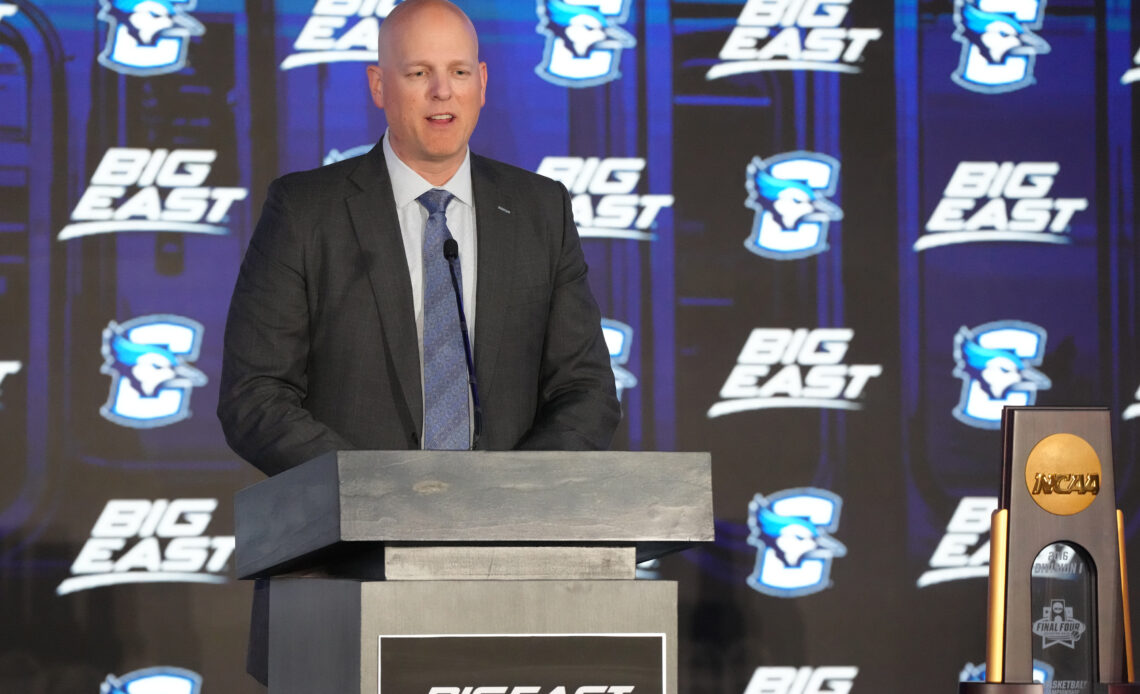
Creighton was picked seventh by the league’s coaches at Big East Media Day on Thursday, a not-so-surprising prediction given what they return (starters Jasen Green, Isaac Traudt and Austin Swartz) — and what they don’t (Greg McDermott). It’s understandable that the rest of the league would be skeptical of new coach Alan Huss’ ability to pick right up where McDermott left off. After all, even last year in a rare down season, they managed to finish in the top five of the league and did so in each of the last 10 seasons.
It’s also nothing new. There’s a fun stat thrown around this time every year about how Creighton has matched or exceeded its preseason projection in all but two seasons since joining the league in 2013-14. That’s a testament to McDermott’s consistent ability to get the most out of his teams.
It’s also a testament to the rest of the league consistently underestimating Creighton, only for the Bluejays to consistently prove them wrong.
When it was time for Huss to take to the stage on Thursday at his first Big East Media Day, the moderator teed up the conversation by asking what’s it been like taking over for quote “a man who’s an institution at your program.”
“It’s difficult, to say the very least,” Huss said. “You know, Coach Mac has been really interwoven with the fabric at Creighton for the better part of a decade, two decades at this point. And trying to replace someone like that is not something you do easily. It’s not something that can be done by one person, it’s being done by committee. And of course I’m doing my best to live up to the legacy that both he and Coach Altman before him have laid. And so, you know, rather than zooming out and focusing on how difficult it is to fill his shoes, it’s much easier just to focus on kind of the day to day at the moment.”
When it was time for the media to ask questions, they were mostly curious to hear if (and how) Huss plans to evolve Creighton’s philosophy, of if his Jays teams will look different than what the rest of the league is used to seeing from Creighton. Jays fans already know one of the big reasons Huss was tapped as the next coach is his familiarity with CU’s systems and his ability to ease the transition by continuing to run what works, but hearing Huss articulate it to a room full of east coast media was interesting.
“I think, mostly, you’re going to see the same things,” Huss said. “I worked for Coach Mac for six seasons before I left for High Point. Did we tweak a few things while I was there? Of course, you know, you grow every year that you’re a part of an organization. Obviously I came back a season ago and leaned back into the Creighton system. I think offensively especially, you’ll see more similarities than you see differences.”
With that said, the roster construction heading into 2026-27 looks a lot different than it has in recent years for the Jays. They’re bigger. Their rotation includes 6’7” Hudson Greer, 6’8” Jasen Green, 6’10” Jackson McAndrew, 6’10” Isaac Traudt, and 6’10” Oswin Erhunmwunse — with 6’9” Fred King, 6’10” Trevon Carter-Givens and 7’2” Wesly Rosa potentially coming off the bench.
“The idea is still to be as skilled as you can. When you think of Creighton basketball, it says ‘Let It Fly’ on our practice floor and on the walls at our facility for a reason. Our program is about shooters and guys that can hit shots from 22 feet away,” Huss said. “When they can do that, and also happen to be 6’8”, 6’9”, 6’10”? It makes it more interesting. It’s not dissimilar to what’s happening with professional basketball. We’re trying to get longer, trying to get more positional size, while at the same time not sacrificing skill. I don’t think we set out to get this much bigger this year, we were just able to do so.”
As Huss has talked about with media in Omaha all spring and summer, they plan to make some tweaks defensively to try and be more disruptive, but the biggest change will be once again having legitimate rim protection in the middle of their defense.
“I don’t think (Mac) would be upset at me for saying this, but a season ago we lost Ryan Kalkbrenner, who was the four time defensive player of the year. That was really the anchor to our defensive philosophy. And we were really at a crossroads,” Huss said. “Then we went ahead and kind of doubled down on what we were doing but with mixed results. We might try a few things differently this year on the defensive side of the basketball, but I think holistically you will see more similarities than differences.”
Talking on Peacock’s coverage of the event, Jasen Green specifically mentioned Huss’ demeanor on the practice floor as the biggest difference between him and McDermott.
“Coach Huss preaches during practice about meeting the standard. We have to approach practice with the same standard every single day with the exact same approach, and he holds us to that every single day,” Green said. “If we’re not having a good day, he’s going to let us know, he’s going to get on us about it one way or another and he gets it figured out. There’s definitely just a little bit of a difference in their intensity levels as well.”
It’s something Huss talked about as well, telling the media that the most important thing for them to figure out is how to get back to the level established by McDermott.
“We had a little bit of a slip up a season ago, and our deal now is trying to have an edge every day when we walk into the facility,” Huss explained. “It’s trying to make sure that we honor the process that’s been laid out by Coach Mac, that we put our own stamp on it at times. We have to make sure that the competitive level is back to what our fans and people around the Big East have come to expect over the last decade and a half.”
He sees Green as one of the key components to that. The senior averaged 10.5 points, 6.3 rebounds and 2.4 assists while (mostly) playing out of position due to circumstance. Huss wants him to be a little more selfish — to look to score himself rather than defaulting to trying to create for others — because he believes Green has another level to his game that can be unlocked.
“Coach Huss thinks that I have the ability to create shots for myself, and sometimes I’m hurting the team by not taking as many shots as I should be,” Green said. “On one hand, it’s me not passing the ball as much, but on the other hand, it’s me creating more for the team and being able to put points up on the board.”
Elsewhere, one of the hot topics of conversation was the recruitment of high schoolers — or in some cases, lack thereof. Villanova coach Kevin Willard said point blank they’re not recruiting high school kids right now.
“We’re not recruiting a high school kid this year, just because of the fifth-year rule. We have six guys that can come back for a fifth year,” Willard said. “So, I’d much rather have one of my players come back, than bring in a high school kid. This kind of reminds me of what happened with COVID. A lot of high school kids, a lot of high school players, got penalized, and it wasn’t their fault.”
UConn’s Dan Hurley said they’re going the opposite route, partially because he sees it as an opportunity and partially because he doesn’t want to stray from how he built their program.
“When people try to get as old as possible, we’re going to make a run at this year at staying young,” Hurley said. “Six of our first nine guys in our rotation are going to be freshmen and sophomores, at a time when people are desperate to be as old as possible, but that’s staying true to how we built this program.”
As for Huss and Creighton? He agrees with Hurley’s philosophy on it.
“I believe that the recipe for success for the last three decades has always been continuity. It’s been getting young players, attracting young players, developing young players, retaining young players,” Huss said. “Whether that’s guys that have multiple years out of the transfer portal or that’s guys from high school basketball, I don’t necessarily care, but we’ve put a huge emphasis on it and we’re spending a ton of time on our class. We’ve got a couple commitments in this [2027] class and we’re continuing to recruit more. We’re going to continue to lean into the high school piece and then honor the process of trying to retain those players as they develop in our program.”
NIL amounts was the other big topic, and according to coaches around the league, the consensus seems to be that $12-15 million is the average budget, with some (St. John’s and UConn) closer to $20m and some (Seton Hall and Butler) much lower. Creighton, Villanova, Providence and Xavier are in between.
“It’s hard to quantify because you’re just not sure what’s real and what’s not real. Some of the things you see online are not accurate,” Hurley said. “Coaches inflate what other coaches are paying their own players, and then they’re going to deflate their own. You know, you’re going to say you paid less and that other people paid more, so it’s hard to really know. I look at it like it’s a poker game, there’s a certain amount that you probably need to have to get in the game. Is that number $14M? Is it $18M to get to a Final Four? I mean, I don’t know exactly what that number is, but there’s certainly a going rate at certain positions if you want to be put together an elite roster.”
Shaka Smart agreed that it’s tough to know real numbers. “I don’t know if there’s a number. It did seem the last couple years that most of the people that made deep runs, did spend a lot. This year, $20 million is a lot, but there are a lot of people doing it. I don’t know the exact number because people aren’t exactly honest about it. You know, there’s a number that you floated your players and then particularly at some of these programs where it’s not all revenue sharing, there’s the number that your players are going to get. That’s something that you guys need to write about. Some of these NIL deals for guys that are at places that are quote/unquote above their revenue sharing cap, some of those will not go realized.”
Seton Hall’s Shaheen Holloway said he’d love to be toward the top or middle of the league, but they’re doing the best they can with what they do have. “Seton Hall is trying to put its best foot forward, with what we have. Do I know we gotta get better? Yes. Do they understand that? Yes…Some schools just got it more than others, man, especially in this league. I can only go with whatever I have and put my team together and try to coach them up.”
While Willard has more resources at his current job (Villanova) than his former school does, he takes an old-school approach to it. “Is there a number? Just because you spend doesn’t mean you spend right,” Willard said. “It’s just like anything else, you have to make great decisions, you have to make the right decisions.”