
From now until Villanova’s first game in Rome on November 1 against Notre Dame, WBR’s Andrew Kresin will run down the 10 other Big East programs as a MISE EN PLACE series. You can check out the rest of the series here.
General Information
- Head Coach: Shaheen Holloway (Fifth season at Seton Hall, 70-65 in South Orange, 134-119 record overall)
- 2025-26 Record: 21-12 (10-10)
- 2025-26 Postseason: Lost to St. John’s in the Big East Semifinals, No other postseason
- Coaches’ Poll Placement: Ninth (31 points)
- Media Day All-Big East Members: None
- 2026-27 Scoring Retention: ~15.3 percent of scoring across two players
Key Returners
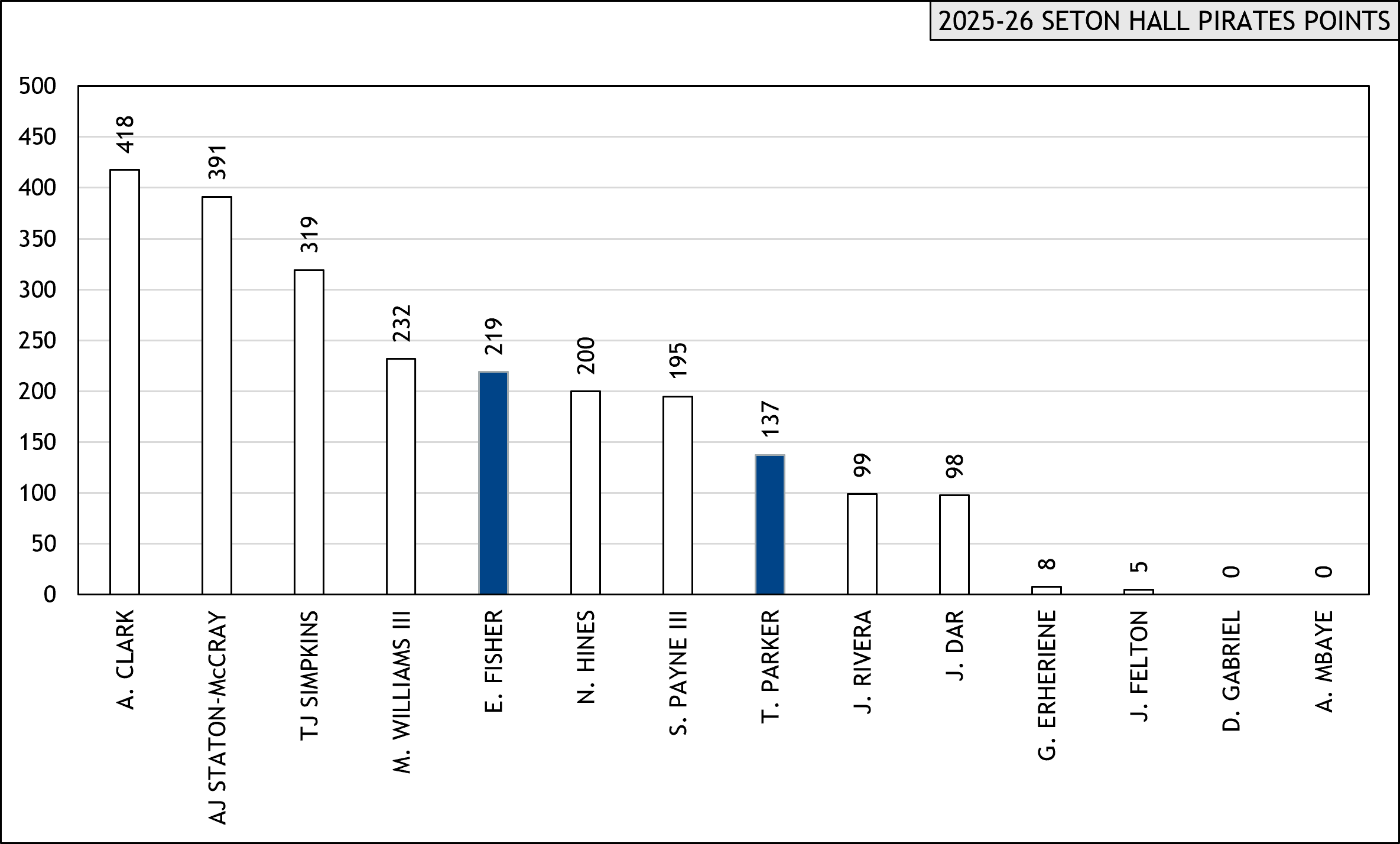
Seton Hall’s roster was gutted of some talented players who could have returned to the Pirates, such as Na’jai Hines, Adam “Budd” Clark and TJ Simpkins. Head Coach Shaheen Holloway was able to retain two pieces from last year’s team who will make an impact on the upcoming season.
The more experienced of the two returners is fifth-year guard Elijah Fisher. Fisher, a 33-game starter last season, played in around 670 minutes and averaged 6.6 points per game in that time. He’s not much of a three-point shooter, shooting just 23.7 percent from three last year, but he makes up for a weak percentage with a career two-point shooting percentage above 50 percent. Despite strong two-point shooting, Fisher did still finish with a career low in his field goal percentage last season at just 45.5 percent on a relatively low usage rate of 17.5 percent.
In his junior year with Pacific, Fisher got to the free throw line much more frequently than at Seton Hall. He took 214 free throw attempts in his junior season but managed only 69 attempts at the line in his first season with Seton Hall. He played significantly more at Pacific than at SHU, which explains part of this drop, but Fisher’s free throw attempt rate also dropped sharply. It should be noted that he was much more assertive defensively while in New Jersey, logging a career high in steals and blocks over last season despite playing around 450 less minutes than in his junior season.
Seton Hall’s other retention is junior guard Trey Parker, who played in 32 games and appeared for around 500 minutes. Parker, like Fisher, saw reduced offensive numbers in favor of defensive success. He doubled both his steals and blocks from his freshman season at NC State to his sophomore season at Seton Hall but saw a five percent drop in his field goal percentage and around a 15 percent drop in his three-point percentage.
Parker did see success in practically every other major non-scoring stat. He became a stronger passer, dishing out 47 assists with a better assist-to-turnover ratio than his freshman season, and was a much better rebounder for Seton Hall. With NC State, he had just one game at or above five total rebounds. At Seton Hall last season, Parker had seven such games, including his career-high eight rebound performance against Creighton in the Big East Quarterfinals.
In Seton Hall’s exhibition against Monmouth, Fisher appeared and started with 10 points and nine total rebounds, while Parker did not play.
Key Transfers
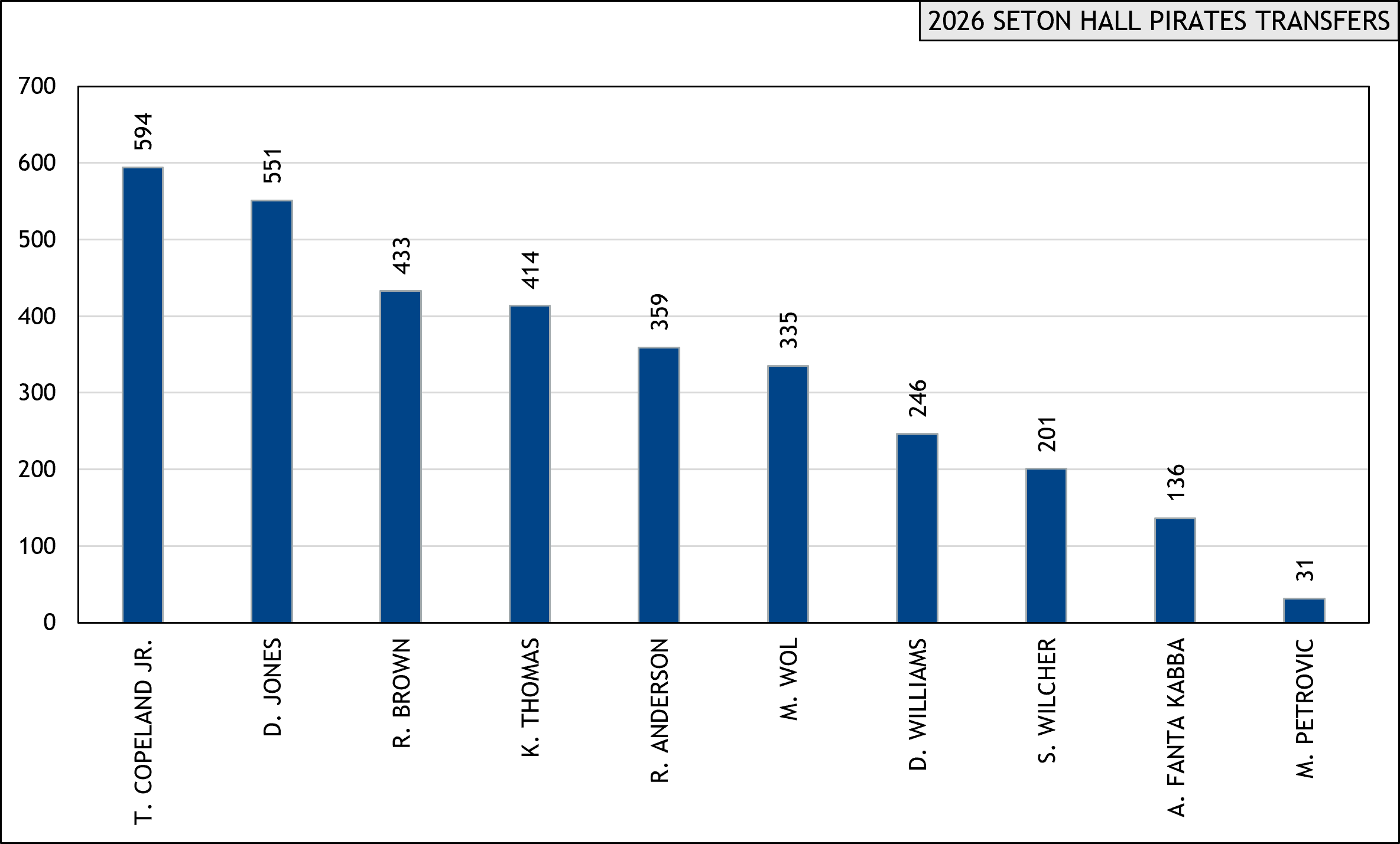
Seton Hall brought in 10 transfers to work around Fisher and Parker, most of whom last played in lower league across the Division One ranks. The only player who came to Seton Hall from below Division One is junior forward Terry Copeland Jr., a product of JUCO Howard College. He won the Player of the Year award in the highest level of NJCAA men’s basketball while averaging 19.8 points and 7.9 rebounds per game. Led by Copeland Jr., Howard College won the NJCAA Division One National Championship Game where he had 23 points and 16 rebounds.
Over the course of a 30-game season, Copeland Jr. had just two games with less than 10 points and scored 30+ points on four separate occasions. On the glass, Copeland Jr. had eight games with double-figure rebounds. It’ll be a tough transition to the Big East, but in his appearance for Seton Hall against Monmouth, Copeland Jr. had 26 minutes in a start, 10 points on 5-of-6 shooting, six rebounds and three blocks.
Copeland Jr. started alongside Fisher and two other Big East veterans in that game. The first, senior guard Simeon Wilcher, was at St. John’s before transferring to Texas to play under Sean Miller. In his two years with the Red Storm, Wilcher appeared in 64 games with 27 starts, averaging 8.0 points per game in his sophomore season but also seeing a large dropoff in his three-point shooting efficiency. When he transferred to Texas, he took a reduced role and saw some of his three-point prowess come back but shot a career-low in field goal percentage.
Where Wilcher saw some improvement is in his playmaking abilities. He played less than in his sophomore season while at Texas, but his assist numbers jumped from 2.1 assists to 3.7 assists per 40 minutes. He also managed to record an assist-to-turnover ratio above 1-to-1, which he had not done since his freshman year with St. John’s. In the Monmouth exhibition, Wilcher managed nine points and two assists across 21 minutes as a starter.
Graduate guard Roddie Anderson was the other Big East veteran to come to Seton Hall after spending two seasons at Xavier. In 33 games and five starts last season, Anderson performed well for Xavier with career highs in shooting percentage and three-point percentage. He was a trusted ball handler for the Musketeers, managing 74 assists with just 44 turnovers. While his assist total dropped, Anderson had his highest assist-to-turnover ratio to date with a 1.68-to-1 mark.
Anderson had a scorching start to conference play with seven consecutive double-figure games. In these performances, he shot just 19.2 percent from three but was taking 13 shots per game. He forced 12 takeaways across 27.9 minutes per game, saw a 2-to-1 assist-to-turnover ratio, and earned two of his five starts in this span. His performance at the start of Big East play, in addition to his team-high four assists in the start against Monmouth, is what Coach Holloway is looking for out of Anderson this coming season.
Senior guard Rodney Brown was a productive reserve for both California and Virginia Tech before transferring to Loyola Marymount for his junior season. While with the Lions, Brown’s offensive game blossomed as he became a player who felt comfortable taking double-digit shot attempts in most games while still scoring efficiently. He shot 38.2 percent from three, the highest mark of any player mentioned so far, while taking 228 attempts over the course of the season. This includes three games with 10 or more attempts and nine games with at least four makes from distance. With this healthy diet of shot attempts, Brown had all but five of his 31 games in double-figures, including four games with 20+ points on the season.
Junior guard Del Jones was the last starter for that Monmouth game. Jones comes into the Pirates’ program from Radford, where he averaged 17.2 points per game and finished second on the Highlanders’ squad in points per game. Jones appeared in three games against high major conference opponents, where he had 22 points at North Carolina, 16 points at South Carolina and 16 points at SMU. As the season continued, he increased his strong offensive performance, averaging 18.9 points per game in his final 20 games. In this stretch, he had just one single-digit performance.
Junior guard Kareem Thomas also joins Seton Hall after a successful year at Dartmouth. In his freshman season, Thomas was an underutilized player with just 62 minutes played all year. In his sophomore season, he played and started in 26 games, played around 750 minutes and scored 414 points, including Ivy League-leading totals in free throws made and attempted. He also shot 44.7 percent from distance while attempting 103 threes on the year. Holloway did not start Thomas in the exhibition, but with his scoring ability, Thomas will be a sparkplug off the bench for the Pirates.
Seton Hall then has this weird mix of either high major talent that didn’t pan out or players from lower leagues with skillsets that Coach Holloway looks for in his players. Junior forward Devin Williams, transfer from Florida Atlantic, led the American Conference in blocks with 85 on the season and was a rebounding monster with 5.2 rebounds (2.2 offensive) per game. Senior forward Mayar Wol won Atlantic Sun Sixth Man of the Year in 2024-25 before transferring to Bowling Green last season where he averaged 10.5 points per game as a stretch forward. Mihailo Petrovic logged just 108 minutes last season with Illinois before transferring into Seton Hall; he scored seven points on perfect shooting from the field. These transfers riddle the bench portion of the Seton Hall roster, likely playing the upcoming season as pivotal reserves for Coach Holloway.
Key College Newcomers
Seton Hall is bringing in just one true high schooler in the Class of 2026. That player, freshman guard Darien Moore Jr., was a top 150 four star in the class who played for Brewster Academy. In his senior season, he averaged 12.5 points, 4.8 rebounds and 2.1 steals per game.
Seton Hall then brings in two international players. Freshman forward Ilay Dolinski is from Israel, averaging 7.7 points and 4.3 rebounds in 20 games playing in Israel’s Winter League. Freshman forward Theo Airhienbuwa, heralding from Italy, appeared in 21 games for Trento in the Serie A 2025-26 season.
All three players appeared in the exhibition game, but none logged more than 10 minutes individually and none scored.
Others
Seton Hall also brought in junior center Abdulai Fanta Kabba from Western Carolina. He averaged 4.7 points and 5.8 rebounds per game in 29 games and 19 starts for the Catamounts.
Outlook
Two things can be true at one time. Coach Holloway’s teams have this gritty identity that emphasizes defense and pressure over offensive success, and even If his teams are undersized or lack the splashy new addition, Holloway usually succeeds. But on the other hand, I understand why this team was picked ninth; the team is depending on several large jumps from transfers that might not be able to make the jump to All-Big East caliber players. With an improved Big East overall, I understand putting Seton Hall in a tier below the middle but simultaneously would not be surprised if Holloway can pull a rabbit out of his hat.
Credits
Seton Hall player information (demographics, player stats from high school, et cetera) found on Seton Hall’s athletics webpage. Player stats from other schools found on Sports-Reference (and Howard College’s athletic webpage). Player rankings from high school found on 247Sports. Charts made in Microsoft Excel.