
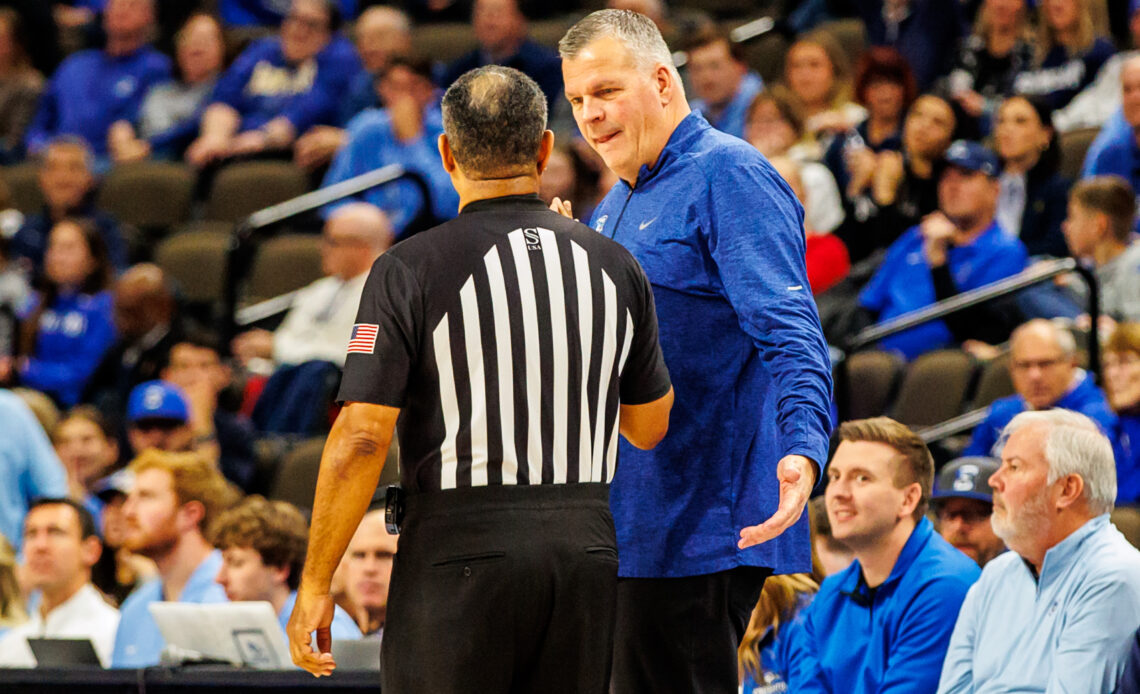
It looked like the 2025-26 season’s low point came in a 71-50 loss at Nebraska. In reality, there was still further down to go, it just took one more half of basketball to get there.
Ahead 23-21 with 9:46 to go in the first half, the Jays made just three more shots the rest of the half — while Kansas State made 12 of their last 19 shots (five 3s, five layups and two dunks). The 30-10 run to end the half turned that 23-21 lead into a 51-33 deficit. CU hasn’t been on that end of things very often at home under Greg McDermott, and while the prolonged run was bad enough at face value, the way it happened was even worse. Poor communication on defense. Late or ineffective closeouts on shooters. Live ball turnovers leading to fastbreak buckets the other way.
“That doesn’t happen in our building,” McDermott said. “What transpired the first half is unacceptable. It’s embarrassing.”
His frustration was broadcast to a national TV audience, too. Normally when FOX’s “In the huddle” feature goes inside a timeout on the bench, coaches censor themselves or are careful not to reveal too much. Instead, when he called timeout to (deservedly) rip into his team with 6:35 to go, FOX captured the whole thing:
“There’s no excuse for no communication! There’s a lot of things you can’t control but THAT’S NOT ONE OF THEM! You’ve got to talk to each other! (Angry clapping) The game is going the way we want it to pace wise. (Long, dramatic pause) But we’re our own worst enemy with our damn communication! (More angry clapping) EVERYBODY TALKS!”
A couple of minutes later, after burning another timeout because the game continued slipping away, FOX’s mics caught McDermott yell toward Nik Graves to “Fight! Play harder!”
After the loss to Nebraska, McDermott said he regretted being too forgiving with this group, and that the standard he holds his teams to had slipped. He alluded to possible lineup changes. But he went further than even the most pessimistic observers figured he would by benching 3/5 of the starting lineup. Out: Graves, Owen Freeman and Blake Harper. In: Isaac Traudt, Ty Davis and Austin Swartz.
He told John Bishop on the pregame radio show that “you’re a fool if you keep expecting similar results or different results when you don’t change something up.” Adding that the new lineup gave them three players who understand what he’s looking for and give consistent effort, it was hard to read it as anything but a shot across the bow to the three players who’d been benched.
The lineup of Davis, Swartz, Dix, Green and Traudt had played together a sum total of 4:54 coming into the game, according to research by Hurrdat Sports’ Jacob Padilla. And it showed early on, as that lineup was on the floor for portions of the game-changing run late in the first half.
On the first possession of the second half, Kansas State got four offensive rebounds and five shot attempts, ending in an uncontested put-back. With the Jays now down by 20, the optics were certainly terrible. But where some saw four offensive rebounds, others saw four good defensive plays to force four tough missed shots — shots that had gone uncontested or unchallenged in the first half. It was the latter that was the actual sign of things to come.
K-State was stuck on 53 points for the next four minutes, as the Jays fought their way back into the game. Traudt buried a three off of a nice assist by Swartz. A minute later he hit a second. And when Davis flipped a pass to Swartz for another three and a 9–0 Creighton run, it forced the Wildcats to burn a timeout.
A 9-0 run for the Jays 🔥#GoJays // 📺 FOX pic.twitter.com/xj6O0w4F9g
— Creighton Men’s Basketball (@BluejayMBB) December 13, 2025
But the Jays weren’t done. Green and Dix combined to block a shot, Dix saved the ball from going out, and then took it 94 feet to the rack for a layup.
We 👀 you @J0shDix #GoJays // 📺 FOX pic.twitter.com/nMP620Blom
— Creighton Men’s Basketball (@BluejayMBB) December 13, 2025
And after a third triple by Traudt plus threes from Davis and Dix, Davis cleared the rebound on a missed shot, pushed the ball up the floor, and threw a no-look pass to Freeman for a dunk. Suddenly, it was 61-55 with 12:25 to go.
Ty Davis with a NO-LOOK PASS to make this an 8-0 run! 👀#GoJays // 📺 FOX pic.twitter.com/LW26SHjOeO
— Creighton Men’s Basketball (@BluejayMBB) December 13, 2025
They’d get no closer at that point, though later in the half they’d close to within three and have a chance to tie the game. But Dix’s would-be game-tying three rimmed out with 2:10 to go, and with it went the momentum behind CU’s desperate rally. The Jays made just 2-of-8 after that miss, and K-State pulled away for an 83-76 win.
“That group the second half fought,” McDermott said. “And you know, that’s what we need right now. I’m gonna play the guys that fight, and and if that means that this deep team isn’t deep anymore, then so be it.”
Creighton’s standards are too high for moral victories to be a thing. But if there’s a silver lining to take from this one, it’s that the Jays have found the top of their rotation going forward — and it’s one that values upholding those standards over basketball skill. Davis, Swartz, Dix, Green, Traudt and Fedor Zugic were the only players who saw the floor in the final nine minutes. Harper played seven minutes and zero after halftime. Graves played nine minutes, and just three in the second half. This wasn’t a soft benching meant merely to reset things, it was a full restart on the pecking order. Is it too late to salvage the season? That remains to be seen. But better late than never.
“I’ve got to do a better job, at the end of the day,” McDermott said. “I’m responsible for the product. I recruited ‘em, I coach ‘em. It’s my job to put them in position to be successful, and if that’s not happening, there has to be a lot of reflection on their part, but also from my perspective. The bench was really short in the second half, and if that’s the way it’s got to be, that’s how it’s going to be.”
Inside the Box:
Kansas State came into the game ranked 12th nationally in three-point shooting, making 40.2% as a team with four players making over 40% from deep. Yet they were even better than that in the first half, going 11-of-17 with 14 of the attempts coming from the four players who shoot 40% or better. Nine of the 11 makes came from those four. That’s a breakdown in the execution of the scouting report that can’t happen.
“Everyone just has to be bought in to what we’re trying to do and game plan,” Traudt said. “I think if we nail the scout every single time, we’ll be in a better position to win, and we have to be able to carry over what we do in practice into the game. We had too many mistakes that cost us.”
The shortened rotation in the second half executed their plan far more successfully, and the Wildcats were just 1-of-11 from three after the break. But it too little, too late.
“If you look at the record of people down 20, it’s a lot to a little. Not many people win those games,” sophomore guard Austin Swartz said. “You can’t be down that much, especially versus a team that can score the ball like they can.”
Swartz was one of the bright spots, again, scoring 12 points with four made three-pointers. It’s his third straight game in double-figures after totaling eight combined points over the first six games.
“I don’t like losing, and it’s been tough, especially when we have the talent to win,” Swartz said. “On the flip side, it was good to see that we have the toughness, that we can get those 50/50 balls, that we can grab rebounds and not give up a whole bunch of offensive rebounds when we want to. So it was really good to see that, but at the same time, a loss is a loss. There are no moral victories here.”
Isaac Traudt had 18 points and seven rebounds, by far his most complete game as a Bluejay in this his third season. The 18 points tied a career high set in December 2023 when he scored 18 against Central Michigan, while the seven rebounds also tied a career high set earlier this year against South Dakota. 15 of his 18 points came in the second half.
But the biggest indicator of a change in the approach for a player who was almost exclusively used as a three-point shooter in the past? Traudt attempted 17 free throws all last season in 36 games, and had taken just 23 in his first two seasons combined. He attempted five on Saturday alone and drew three fouls.
Josh Dix also had 18 points on 7-of-17 shooting, with seven rebounds, two assists and two blocks. It’s his defense that continues to be the unsung hero, though. He played 35 minutes as the primary defender on PJ Haggerty, who came into the game as the nation’s leading scorer averaging 24.0 points per game. He was 4-of-12 from the floor and scored 10 points, his lowest scoring output in nearly a year and just the second time in two seasons he’s been held to as few as 10 points in a game.
Last weekend, he held Nebraska’s leading scorer, Pryce Sandfort, to 12 points on seven shots. Sandfort had 32 in their win at #13 Illinois on Saturday. He also was the primary defender on Oregon’s Jackson Shelstad, holding their top perimeter threat to a season-low nine points on 4-of-15 shooting.
Is his terrific defense coming at the expense of his own offensive production? It’s possible, considering he’s made just 34.5% from three through 10 games after shooting 41.9% from deep over three seasons at Iowa. He was 2-of-7 from three on Saturday, with one of the misses being the shot with two minutes to go that could have tied the game.
“Josh has been terrific,” McDermott said. “To be honest, I’m asking him to do too much. We need him to be a guy that shoots 12 to 16 shots a game, but that’s a lot to ask when you’re chasing around the other team’s best player too. Right now, the gap between what he’s able to do defensively and the next guy is really too large to take him off the floor for very long.”
Jasen Green scored just six points but grabbed eight rebounds, adding three assists and a block. Ty Davis played 30 minutes after only playing more than 20 in a game one other time in his career (24 against San Diego State last November when Steven Ashworth was out with an injury). He had five points on 2-of-3 shooting, made 1-of-2 from three, and dished out five assists against just one turnover. More importantly, he ran the offense at the pace Creighton expects to play at, was a big part of their improved ball movement, and played with the kind of effort and communication expected of a Bluejay point guard.
“I thought Ty did a great job,” Traudt said. “He’s extremely unselfish. He’s always trying to make plays for others. He competes as hard as he can every single play, and that’s just the type of guy he is.”
“I thought all the guys that started today did a good job,” McDermott added. “You know, I thought Ty competed and fought. Did he make a few mistakes? Absolutely. Is he going to make a few? Yes, and that’s okay. Isaac got a couple of big offensive rebounds late and he’s doing whatever we ask him to do. Those guys had a good point when we were talking to the media in there a few minutes ago. Isaac and Austin were on the scout team because at that time we hadn’t had the injuries yet, and we had a lot of guys and too many guys were standing in practice. I asked them to move over to the scout team, and had them play as the other team’s best players. Ty was over there too, along with Austin. They didn’t complain about it, they didn’t hang their head, they didn’t get into themselves. They asked questions about what the scout was and what our defensive plan was. Basketball has a way of paying you back when you do things right.”
As for the players who lost their starting roles, McDermott didn’t pull any punches. Asked by John Bishop on the pregame show how they took the news, he said “obviously nobody likes it, but that’s that’s life, man. Sometimes you have to change things up, and just like those guys that were on the bench that were supporting them when they were in the starting lineup, my expectation is you do the same. If they’re not capable of that, then you’re probably not going to see them on the floor a lot.”
Then he dropped more hints about things going on behind the scenes.
“I think having more guys on the floor that have been here that understand what this logo means is helpful,” he said. “Ty, Jasen and Isaac were out there to start the game, and Fedor (Zugic) played quite a bit in the second half. That’s important, especially when you’re struggling. When you’re struggling, it’s easy to point the finger and blame somebody else. This program means a lot to those guys. I’m not sure that any of the guys that have transferred here in the past, after only being here three or four months, that the program means to you what it does after you’ve been here for a while. We’ve got some guys that are still learning that, and it’s got to be a quick education.”
Highlights:
Box Score: