
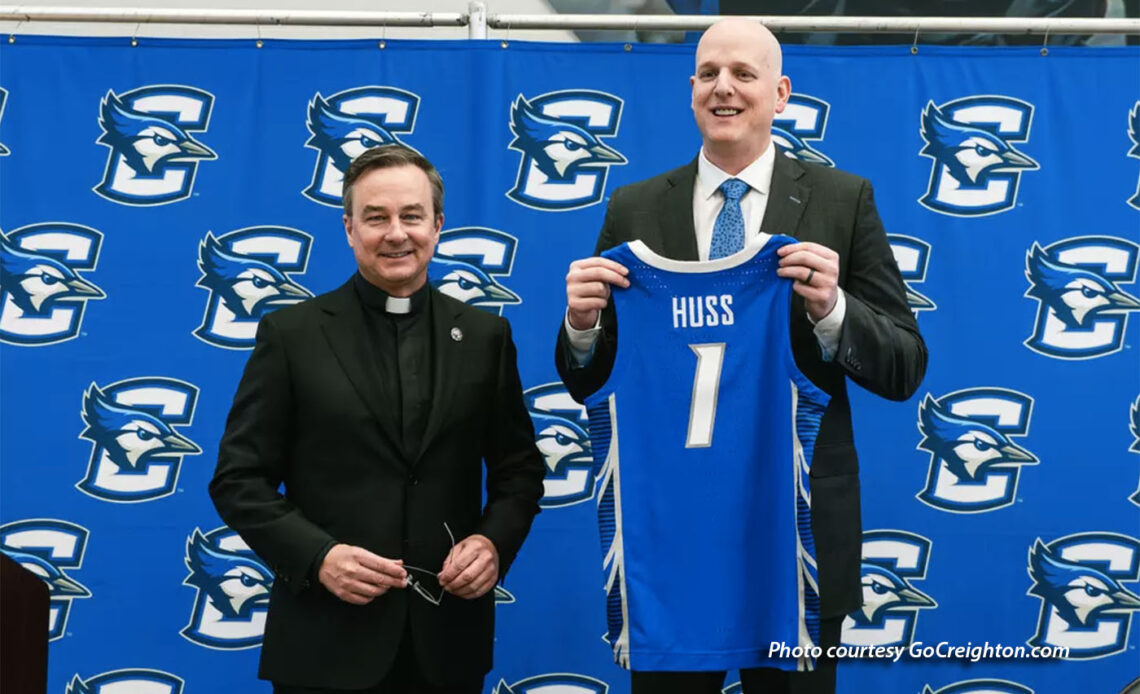
Wednesday morning’s event to officially announce Alan Huss as Creighton’s next head coach was billed as an introduction, but in this case that term was more customary than accurate. A player for Dana Altman and an assistant for Greg McDermott, Huss needs no introduction.
“Alan is a Creighton Bluejay in every sense of the word,” Creighton President Fr. Daniel Hendrickson, SJ said in his opening remarks. “He’s an alumnus. He’s a former player. He married a Bluejay. And in recent years he helped build the culture that defines the program today. He’s ready to lead and I’m confident that he will guide Creighton basketball into the next era with energy, with great expertise and with a clear commitment for success.”
“I know he’s been here for a year, but I want to welcome the entire Huss family back to Creighton,” athletic director Marcus Blossom said, before joking that Huss had carried the Jays to multiple NCAA Tournaments during his time as a player.
Huss was part of three NCAA Tournament teams (1999, 2000, 2001), two Missouri Valley Conference Tournament titles (1999, 2000) and one MVC regular-season title (2001). He played in 94 games with the Bluejays, including 39 starts. The often-frustrating nature of his time as a player was underscored by a hilarious (and touching) anecdote Huss shared once it was his turn at the mic; that the story name-dropped team physician Dr. Lee C. (Doc) Bevilacqua, team chaplain Rev. Robert Hart, S.J., former coach Red McManus and former athletic director Bruce Rasmussen underscored how Huss is woven into the fabric of Creighton basketball.
That trio would normally sit together at the end of the Creighton bench at games during the 1980s and 1990s, getting on both the officials and the Bluejay players as they ran past. Late in his senior season, McManus asked Rasmussen for confirmation that Huss was in fact a senior. Rasmussen replied that he was, then followed up by inquiring why McManus was asking.
“And without hesitation,” Huss recalled, “Red looked right at him and said, ‘I just wanted to make sure I never have to watch him play again after this year.’”
Huss recalled that early in his freshman season, he contracted pneumonia. “I think back to Doc taking me into his home and caring for me like his own son,” he said. “And I think back to what this place is about, what it means to me, what it means to so many people in this room. And I think back to Doc. I think about his selfless attitude towards not only the people here at Creighton, but also his clinic in South Omaha. There’s no better example of how someone at Creighton should behave, how someone at Creighton should act, how somebody that really lives their Ignation values should live daily.”
“That trio of human beings showed us so much love, and it was really the first time in my life around the game of basketball that I met people outside of just immediate coaching staff that impacted my life. Those three guys, I think about them. I think about what they meant to this university. And I hope that as we move forward in this process, all the student athletes here will get a little bit of that from other people on this campus. I aim to be one of those people.”
A quarter-century later, Huss is officially the 17th head basketball coach in program history, succeeding a pair of giants in Dana Altman and Greg McDermott. There’s no doubt another trio of giants — Doc, Red, Fr. Hart — are looking down and smiling as Huss takes over.
“It’s impossible not to sit and reflect just a little bit on how fortunate I am to be where I am right now and how fortunate we are as a family to be where we are right now,” Huss said. “I promise you that this is not going to be taken lightly by me. I promise you that this means a lot to me.”
With the press conference out of the way, Huss begins the process of planning for next season while someone strangely also preparing to play next week in the Crown. In an interview on 1620AM’s “Happer and Schaefer” on Thursday, Huss said the preparation ahead of that tournament is almost more valuable than the games themselves for a coach evaluating what he wants his roster to look like next season.
“The practice sessions that we’ve been afforded in preparation for the Crown will give us a great look at where guys’ mentalities are,” Huss said. “Are they in wind down mode right now, where they’re thinking, ‘OK, how do I just, how do I get through this next little period before we start back in June?’ Or are they in ramp-up mode? And I think guys in that second category are the ones that we want to gravitate towards. We’ve got a few guys in both categories. But those guys that really love basketball, that want to get better, that no matter the time of year, no matter what the situation with the team is, they’re thinking about getting better, they’re thinking about their craft, they’re thinking about our program? Those are the guys that do really well when they come back and we flip to the next season.”
He added that the idea of hitting the ground running is a not quite right — he and the staff never stopped, which is one of the perks of a transition like this. March and April are roster management season, and you can’t afford to lose even one day.
“We’re fully entrenched in our conference room and it’s working right now as our war room,” Huss said. “We’re trying to make sure that we retain the right guys and keep the guys that want to be in our program here, and then find some additional bodies to supplement what we do.”
He noted that he’s still working through what the staff and program will look like operationally, and that while some members of McDermott’s staff could potentially move on, he anticipates a lot will stick around.
“I think you’ll see more continuity than anything in our program. That was the aim when we put this plan into motion,” Huss said. “Fortunately, I’ve got relationships with most of these guys, and we’re going to try to push it forward together.”
On the court, Huss alluded at his press conference to a desire to be more disruptive on the defensive end of the floor. On 1620, he expanded on that thought. Huss noted that he’s had conversations with McDermott about that idea for awhile, and how to adjust to life without Ryan Kalkbrenner in the middle.
Interestingly, he talked about how they’ve used advanced metrics as part of that discussion, specifically turnover rate compared to foul rate. They got away with being less aggressive — not fouling, and not turning teams over — when they had Kalkbrenner anchoring the defense at the rim.
“Without him, we are not creating enough turnovers based on the number of fouls we are committing,” Huss said. “We’re going to try to be a little bit more aggressive with our hands on the basketball and see if we can’t deflect some more passes and start possessions with an advantage maybe three or four percent more of the time. That doesn’t sound like a ton. But in collegiate basketball, so many of the games are decided by two or less possessions. And so, a slight tweak like that can hopefully lead to more run-out opportunities and maybe flip a game. Being disruptive means not allowing teams to come down in rhythm and just run exactly what they want, and banking on our abilities and our defensive discipline to overcome it. So it’s just a slight shift in mentality and maybe just a slight strategic shift as well.”
He says they’ll make it a bigger point of emphasis to deflect the ball and be more disruptive with their hands defensively. But beyond that, he also thinks a strategic shift in how they defend screens is in order.
“The common rule for us has been to try and avoid rotation at all costs,” Huss noted. “And I think we’ve come to the determination now that at times rotation is necessary. We’ve got to be more effective on our rotations rather than being hyper-obsessive over staying out of them.”
Offensively, Huss said fans will recognize 99% of what they do from past teams.
“’Let It Fly’ has been a huge part of why we’ve been able to to develop our brand as one of the premier offenses in college basketball,” Huss said. “There’s no reason to fix what’s not broken. We will continue to let it fly. I will continue to recruit talented student athletes that share the ball, that are unselfish, and that want to play at that tempo. That’s not going to change.”
As they pitch recruits on Creighton, Huss said that while NIL and the transfer portal have changed the landscape, the most important part of CU’s sales pitch hasn’t changed. Creighton is a small Jesuit school in Omaha, but offers educational opportunities not found at other places who may be recruiting them — and a large, devoted, passionate fan base who fills their arena.
“It’s pretty simple. Central to a healthy downtown Omaha is a healthy Creighton University, and central to a healthy Creighton University is a healthy men’s basketball program, and a healthy athletics department just in general,” Huss. said. “So, we’ve got to do our part. We’ve got to get our guys back to playing with joy and get the fan base engaged. We understand our responsibility in the equation, and know that we’ve got to be a little bit better to get people excited.”
“We didn’t play to the level that we expected this year,” he added. “We didn’t perform there. And that’s our responsibility. We’re going to work diligently to try to get back to where it was for the first 15 years of Coach Mac and most of the 16 years under Coach Altman, playing with joy and playing with passion and making sure our fans are excited about it.”