
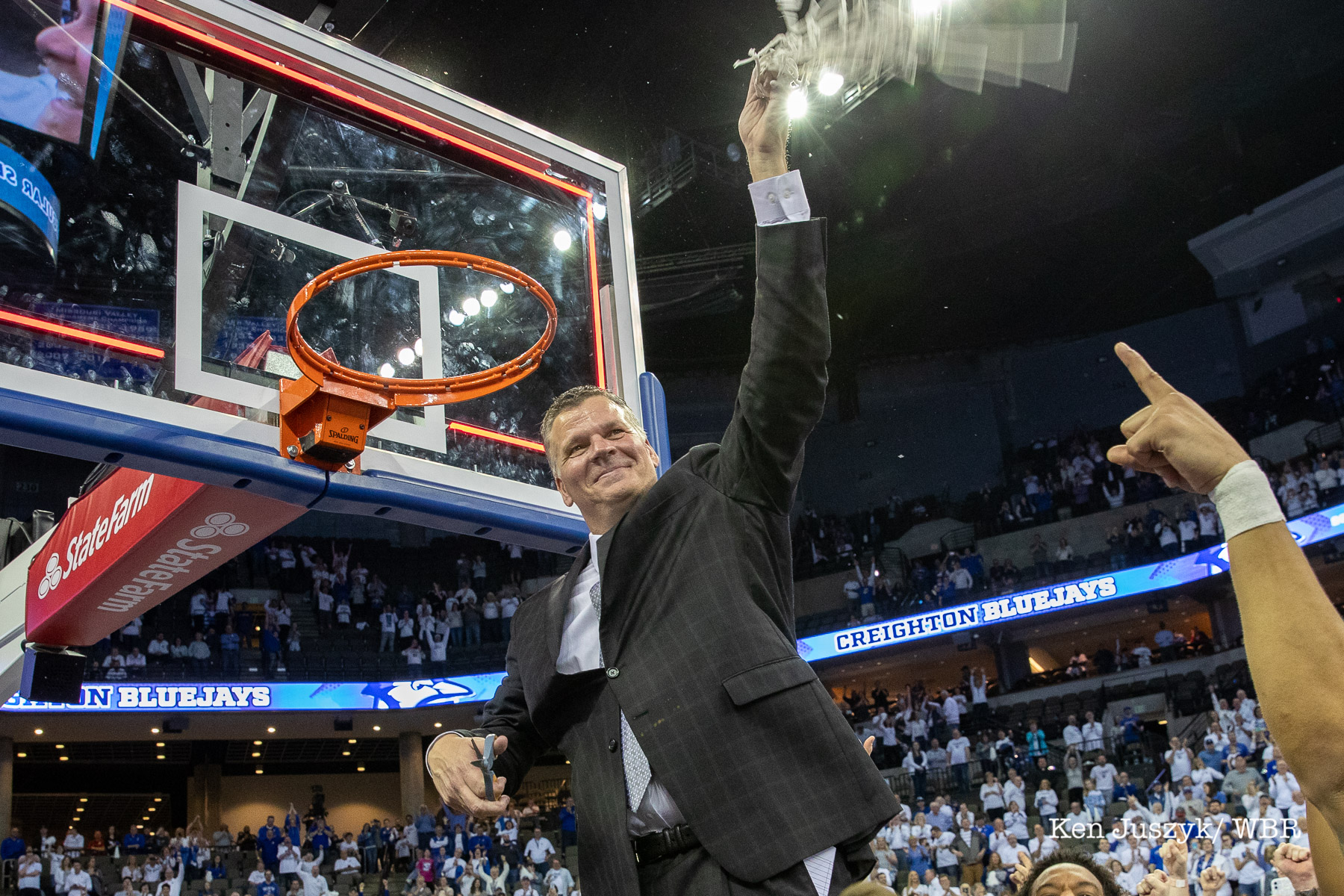
Greg McDermott announced his retirement today, officially making Alan Huss the 17th head basketball coach in Creighton history. He leaves a staggering legacy behind, building a skyscraper of a program on top of the foundation Dana Altman (and others before him) laid.
“It has been an incredible honor to lead the Creighton men’s basketball program for the past 16 years,” McDermott said in a release provided by Creighton Athletics. “I’m very proud of the young men that have proudly worn the Bluejay uniform and represented our program in a first-class manner. Witnessing their growth and development on and off the playing floor was especially gratifying.
“I’m deeply grateful for the support of my family, our players, coaching staff and support staff, as well as the presidents, athletic directors, and all the University and athletic administrators. The support of the Omaha community consistently packing our arena with 17,000 fans has created many fond memories.
“While this chapter of my career comes to a close, my love and respect for the Bluejays will never fade. I look forward to the continued success of Bluejay basketball under the leadership of Alan Huss.”
In 16 seasons at Creighton, McDermott’s teams had 20 or more wins 14 times. He took them to 10 NCAA Tournaments, winning at least one game in eight of the 10 appearances and advancing to three Sweet 16s and one Elite Eight. He took them to two NITs and one CBI, winning two or more games in all three.
He led them to ten consecutive top-five finishes in the Big East. During three seasons in the MVC, they won the tournament title twice. In the other 13 seasons as a member of the Big East, they didn’t win the tourney title but advanced to the title game five times, and won the regular season Big East title in 2020. His 365 wins are the most in CU history, and his 147 wins in Big East play are sixth-most in the history of that storied league. The only coaches with more are five of the biggest names in the history of the sport: Jim Boeheim, Jim Calhoun, Jay Wright, John Thompson and Rick Pitino, all of whom are enshrined in the Naismith Hall of Fame.
The Championship Center now bears his name for good reason.
None of that was assured when he was announced as head coach on April 26, 2010. There were certainly skeptics when he took this job after an unimpressive stint at Iowa State, fearful of the program backsliding after a long period of success. Instead, that would be the destiny of their MVC rival Wichita State, who misfired replacing Gregg Marshall and has wandered the college basketball wilderness ever since. McDermott went the opposite direction, taking Creighton higher than they’d ever been before.
In hindsight, the skeptics should have known better. He’d won, and won big, pretty much everywhere else, starting at Wayne State where he led the Wildcats to four-straight 20-win seasons, one Northern Sun Conference title and a pair of NCAA Division II Tournament appearances, including a Sweet 16 berth in 2000. After going 15-11 in one season at North Dakota State, he took the Northern Iowa job and did something few thought possible: built UNI into perennial winners. The Panthers finished 7th, 8th and 10th in the three years before he was hired, and had little to show for their two decades as a D1 program. In 2001, they were 12 years removed from their only D1 postseason berth, played their home games in the corner of a football dome in front of 1500-3000 fans a night, in the shadow of the giant state U just an hour up the road.
McDermott identified the types of players he wanted and then went out and got them, challenging Creighton for under-the-radar Iowa talent and building recruiting pipelines into Minnesota and Wisconsin. His teams were a reflection of the Cedar Valley they called home: tough, hard-nosed, making the most of what they had to compensate for what they didn’t. To make up for a lack of athleticism, they played tough defense and tried to control the pace. To make up for a lack of depth, they gave the majority of the minutes to six or seven players.
They might be beaten, but they were never outplayed or outcoached. McDermott immediately doubled the Panthers win total from 7 to 14 in his first season, and by year three they won 21 games and secured an NCAA Tournament berth. As a 14-seed matched against eventual national runner-up Georgia Tech, they missed a game-winning three at the buzzer.
In year four, they again won 21 games and earned the program’s first at-large bid to the NCAA Tournament. As an 11 seed against Wisconsin, they once again were within a single possession in the final minute, and once again missed two shots to tie or win it.
And in his fifth and final year, UNI collected non-conference road wins at #13 LSU and at Dayton. The veteran squad earned the first Top 25 ranking in school history in January, and despite finishing fifth in a loaded MVC, earned an at-large bid to the NCAA Tournament, jumping over fourth-place Creighton to snag the fourth MVC bid and igniting Billy Packer into a blathering fool on national television. Armed with a 10 seed, the Panthers fell to 7th seeded Georgetown 54-49, as 7’2” center Roy Hibbert proved too much for the Panthers’ bigs.
In four years at Iowa State, his teams went just 59-68 and won only 18 games in Big XII play. He struggled to recruit power conference talent and struggled to retain players. Still, he left ISU better than he found it, as he navigated them through both a recruiting scandal and NCAA sanctions stemming from a lack of academic progress under the previous coach; he was behind the eight-ball from the start, with two fewer scholarships to award as a result of those sanctions. He was the bridge from Wayne Morgan’s tumultuous tenure to the far more successful Fred Hoiberg era — and introduced T.J. Otzelberger to Ames, as he served on McDermott’s staff all four years. Without Mac’s tenure at ISU, it’s unlikely Otzelberger is there now, piloting a perennial national contender.
Which brings us to Creighton.
When he was introduced as CU’s head coach, Bruce Rasmussen identified the five criteria he used in selecting McDermott to be the next head coach of the Bluejays.
- Someone who had documented success as a head coach at the Division I level, “experience at a level that we aspire to compete. That is, a nationally-relevant program in men’s basketball.”
- Someone who understood Creighton, the Missouri Valley Conference, the Midwest, “and who understood what it was to be the head of a major college basketball program in this country.”
- Someone with “great passion for the game, great intelligence in teaching the game, and great character.”
- Someone who is a great family man, and “someone who understood the emotions these young men and their families feel.”
- Someone who is a great teacher and has demonstrated an ability to develop players.
“I am confident that as you get to know Coach McDermott, you will see that he is an absolutely perfect fit for that position,” Rasmussen added that day.
As usual, Ras was exactly right. The resume speaks for itself:
- 365 wins (CU MBB record)
- 147 Big East wins (CU MBB record; 6th league history)
- 10 NCAA Tournament trips (CU MBB record)
- 12-10 NCAA Tournament record (CU MBB record)
- 3 Sweet 16’s (2020-21, 2022-23, 2023-24)
- 1 Elite Eight (2022-23)
- 121 weeks in AP poll (CU MBB record)
- 43 Top 25 wins (CU MBB record)
- 17 Top 10 wins (CU MBB record)
- 14 seasons of 20+ wins (CU MBB record)
- 14 Postseason trips (CU MBB record)
- 6 NBA Draft Picks (3 First Round, 3 Second Round)
- 2 MVC Tournament titles (2011-12, 2012-13)
- 1 MVC regular-season title (2012-13)
- 1 Big East regular-season title (2019-20)
- 1 National Player of the Year (Doug McDermott)
- Over $1 million raised for Hope Lodge
The McDermott Era can be divided into four distinct groups who all competed for conference titles, each building on each other and taking the program higher than the one before. The first, featuring Grant Gibbs, Jahenns Manigat, Doug McDermott and Ethan Wragge, combined for 107 wins in four years, with one regular season MVC title, two MVC Tourney titles, and wins in three consecutive NCAA Tournaments. That group equalled Altman’s two NCAA Tournament wins after just three seasons, with both coming as a member of the MVC — then added a third after joining the Big East.
The second era, featuring Mo Watson, Marcus Foster, Khyri Thomas and Justin Patton, won 66 games over three seasons and lost in the first round of the NCAA Tourney twice. But those numbers have a big asterisk: the 2016-17 team started 13-0 and 18-1 before losing Watson to a season-ending injury, and were on track for a historic season.
The third era was the one that finally got them to the next level. Headlined by Ty-Shon Alexander, Mitch Ballock, Damien Jefferson, Denzel Mahoney and Marcus Zegarowski, they won 87 games in four years, won the Big East regular season title, and advanced to the Sweet 16 for the first time since 1974.
And the fourth, led by Ryan Kalkbrenner, Trey Alexander, Ryan Nembhard, Arthur Kaluma, Baylor Scheierman and later, Steven Ashworth, topped them all. That era saw more turnover than the past ones, given the NIL and transfer portal realities of current college basketball, but that group (such as it is) won 97 games and went to two more Sweet 16’s and an Elite Eight. They beat six Top 10 teams, including victories over a pair of No. 1s (UConn and Kansas).
But the real window into McDermott as a coach and a leader didn’t come after any of his 365 wins. To find that, you need to look to the aftermath of the two most devastating defeats during his tenure: the grim locker rooms after losses to Baylor in the 2014 NCAA Tournament and to San Diego State in 2023.
After the loss to Baylor ended the Doug McDermott/Gibbs/Wragge/Manigat short of the Sweet 16 they so desperately wanted, he refused to let his team hang their heads.
“Don’t you dare let this be any part of the memory of our four years together,” he told the team that night. “You guys have raised the bar for our basketball program and the way you’ve done that…it’s far more impressive than what you’ve done on the floor. We all hurt right now. We didn’t want this to end. Why would we? We were having the time of our lives.”
“You guys have left your mark all over the record books, but more important, you guys have been mentors to so many people. You have no idea the impact that you’ve had on young people, that you’ve had on people that are down on their luck because they’re sick or they’re fighting a disease, the number of times you visited someone elderly. How many times have you guys gone to visit someone that’s in the last couple months of their life? You never said no. And that’s why you’ll be so good at whatever you choose to do. It’s been a pleasure to coach you.”
And after a last-second defeat to San Diego State in the 2023 Elite Eight where the temptation was very strong to direct anger towards an officiating crew that made a controversial call to set up the winning free throw, McDermott refused to go there. Where he did go turned into a viral moment of inspiration that showed a national audience what Creighton fans already knew.
“You have rallied and galvanized not a university, not a community, but anybody that’s ever had anything to do with Creighton University,” he told his team in the locker room. “They’ve all stopped their lives for the last couple Fridays and Sundays to watch you guys do what you do, and I couldn’t be more proud of the way you did it. That’s why we were able to climb a mountain nobody that’s ever worn this uniform has climbed.
We can hurt. We can be disappointed. But we damn well better be proud. I can’t tell you how much I appreciate the opportunity to be your coach. I love every one of you everybody in this room. What happened out there is not renting a space in our head and our heart, because then we got to go through it over and over and over again. We went through it once and it’s over. We’ll be back in this game, I promise you that.”
Looking back through WBR’s archives, of the 553 games he coached at CU, I published an article on 541 of them. Of all the coaches’ interviews I transcribed in that time, McDermott’s ability to describe X’s and O’s, game strategy, and why things happened the way they did consistently amazed me. His willingness to let us in on nuts-and-bolts details that other coaches brush past with cliches and non-answers consistently taught me something new. Listening to him for 16 years was the equivalent of taking a masters class in basketball strategy, and I’ll miss it.
The same is true of his enormous coaching tree, made up of former assistants who he freely shared his knowledge with and then empowered to run parts of the program that other head coaches insist on doing themselves.
- Darian DeVries (Indiana)
- Eric Henderson (Drake)
- Ben Jacobson (Northern Iowa)
- Steve Lutz (Oklahoma State)
- Ryan Miller (Murray State)
- T.J. Otzelberger (Iowa State)
- Bryan Petersen (South Dakota State)
- David Richman (North Dakota State)
- Daniyal Robinson (North Texas)
- Paul Sather (North Dakota)
- Patrick Sellers (Central Connecticut State)
And now that list includes his successor, Al Huss. When McDermott introduced himself back in April 2010, he called the Creighton job not a “rebuilding” project but a “retooling” job.
“Coach Altman has done an unbelievable job during his tenure building this program to the level that it is. I understand that those are huge shoes to fill, not only because of what he meant to this University and this basketball program, but because of how he was thought of in this community. I take that responsibility very seriously,” McDermott said that day. “This isn’t a rebuilding job — it’s a retooling job. We need to tweak some things, maybe put our stamp on it, but these guys know what it takes to compete for championships, and we’re going to try to pick up right where coach Altman left off.”
Huss inherits a similar situation, one where he needs to tweak some things, one where he’ll undoubtedly shift the style CU plays slightly, but one where he’s set up to win right away. And his words in the press release announcing his elevation to head coach echoed McDermott’s from 16 years before.
“I am incredibly honored and humbled to be named the head men’s basketball coach at Creighton University,” Huss said. “This University has meant so much to me as a former player, as an alumnus and through the seven years I’ve spent serving this program. Creighton helped shape who I am, and the opportunity to now lead this program is something I do not take lightly.
“I want to sincerely thank Fr. Hendrickson and Marcus Blossom for their trust and belief in me. I also want to express my deep gratitude to Coach McDermott, who elevated this program to national prominence and built a culture of consistency and excellence that is respected across the country. I am grateful for the opportunity to learn under his leadership and for the belief he has shown in me throughout this transition.”
McDermott will coach the Jays next week in The Crown, and then the program is officially Huss’ to run and mold in his own image. The program he inherits is light years away from the one he committed to as a player in 1997. At that point, the Jays had won just one NCAA Tournament game in the past quarter century, going winless in the big dance between 1974 and 1991. They were still digging out of the wreckage of the Rick Johnson era, a disaster that left some questioning if they should drop D1 sports altogether. The teams Huss played on from 1997-2001, and the ones that came after he left, laid the foundation for what’s followed.
Now he gets a chance to add an addition to the skyscraper McDermott built on top of it.